
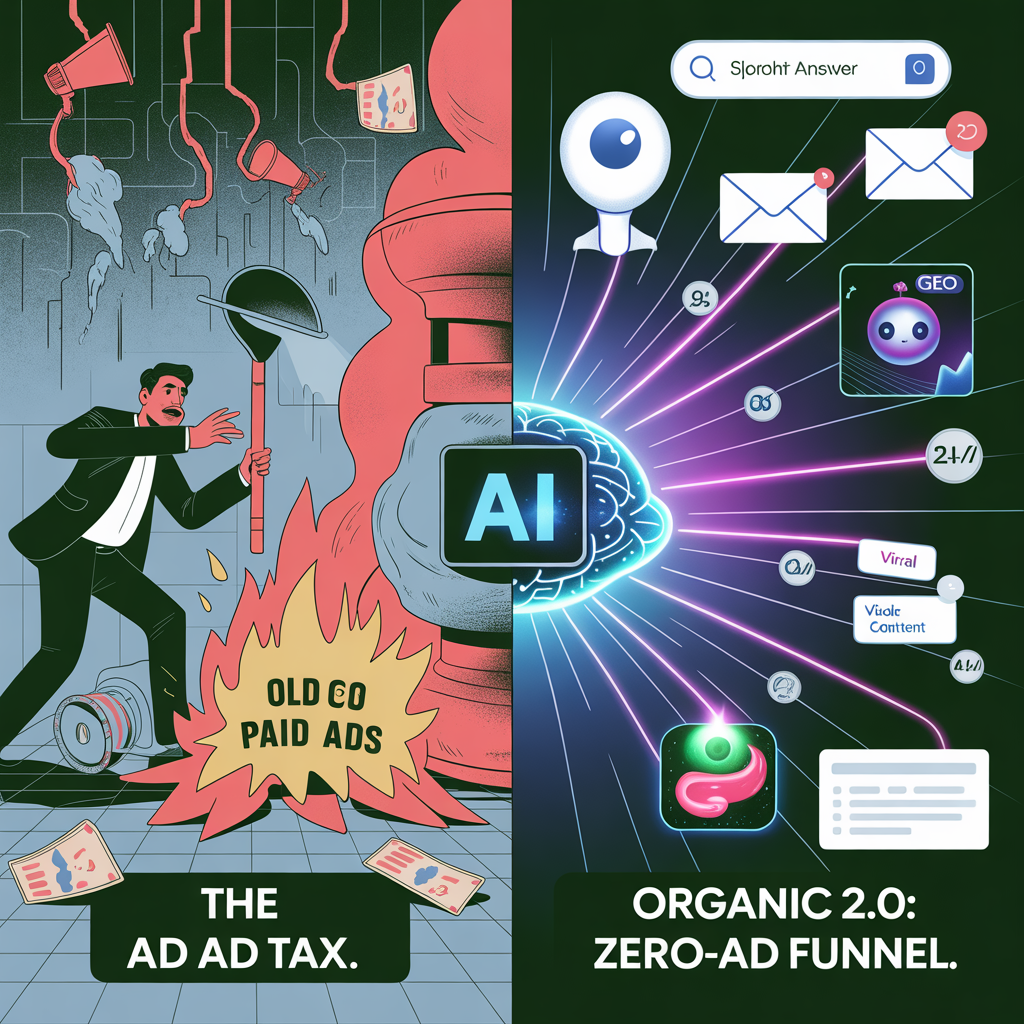
If you read our last post, you already know the harsh truth: Traditional ads are dying. While CAC doubles, smart brands are shifting to Content AI strategies to survive the coming year.
The cost to acquire a customer (CAC) in India has nearly doubled in the last two years, while conversion rates on Facebook and Google are plummeting. So, you stopped burning money on ads. Good. But now what?
How do you get leads? Do you just post on LinkedIn and “hope” for the best?
Here is the reality check: Most businesses are using Content AI completely wrong. They use ChatGPT to write boring emails or generate generic blog posts. That isn’t a strategy; that is just noise. Using AI just to “write faster” is like buying a Ferrari to drive to the grocery store at 20 km/h. You are missing the point of the engine.
The real opportunity in 2026 is “Organic 2.0″—an automated system driven by Content AI that finds, nurtures, and converts leads without you spending a single rupee on ad spend.
We aren’t talking about “posting more.” We are talking about building a Zero-Ad Funnel where machines do the heavy lifting. Here is the 3-step blueprint to build it.
[Insert Image Here: Alt Text = “Content AI marketing funnel strategy diagram”]
Step 1: Top of Funnel (Getting Found with Content AI)
From SEO to “GEO” (Generative Engine Optimization).
For the last 15 years, the goal was simple: Rank #1 on Google. But as we enter 2026, user behavior has shifted. People aren’t just “Googling” anymore—they are asking AI.
- Old Search: “Best digital marketing agency Delhi” (User scrolls through 10 blue links).
- New Search: User asks ChatGPT or Gemini: “I need a digital partner in Delhi that specializes in AI. Who should I hire?”
If the AI doesn’t know who you are, you don’t exist. This is the birth of GEO. Traditional SEO was about keywords; Content AI is about context and authority. AI models like GPT-4 and Claude don’t just count keywords; they read the entire internet to understand “Who is the expert?”
How to optimize for the AI Age:
- Stop “Stuffing” Keywords: AI is smart. If you write for robots, AI will ignore you. If you write high-value, deep content that answers complex questions (like this blog), AI will cite you as a source.
- Digital PR & Citations: AI models learn from trusted sources. If your brand is mentioned on authoritative platforms, the AI “learns” that you are a legitimate player.
- Structured Data is King: You need to speak the AI’s language using technical schema markup.
The Goal: Position yourself so that when your customer asks an AI for a solution, Webblendz (or your brand) is the only recommendation it gives.
Step 2: Middle of Funnel (Engagement)
Hyper-Personalization at Scale.
The old way of doing outreach was “Spray and Pray”—sending the exact same cold email or LinkedIn message to 1,000 people. In 2026, that guarantees you land in the spam folder.
The new way is AI “Agentic” Outreach powered by Content AI.
Imagine hiring a sales team of 50 people to research every single prospect before sending a message. Now, imagine doing that with software for a fraction of the cost.
The Strategy: Tools like Clay or Instantly.ai allow us to build “Waterfalls.”
- The Scan: The AI scans a prospect’s LinkedIn profile and website.
- The Analysis: It reads their recent posts to understand their current pain points.
- The Draft: It writes a 100% unique message that references their specific problems (e.g., “I saw your post about hiring difficulties…”).
It feels like a human wrote it, but an AI agent did it for 500 people in 10 minutes. This isn’t spam; it’s relevance at scale.
Step 3: Bottom of Funnel (Closing)
The 24/7 AI Sales Closer.
You’ve got traffic (GEO). You’ve got engagement (Agentic Outreach). Now, how do you close them?
- Old Way: “Fill out this form and we’ll call you back in 24 hours.” (Result: Leads go cold).
- New Way: Conversational AI Sales Agents.
We aren’t talking about those dumb “Press 1 for Support” chatbots. We are talking about custom-trained AI agents embedded on your site. These agents are trained on your specific business data.
What an AI Agent can do:
- Answer complex questions about your pricing and services instantly.
- Handle objections (e.g., “Why is this expensive?” → “Compared to hiring an in-house team, this saves you 40%…”).
- Book meetings directly into your Google Calendar.
While your competitors are sleeping, your AI agent is answering questions and closing deals.
Step 4: The “Viral Loop” – Content AI Repurposing
Consistency is the hardest part of marketing. Most founders don’t have time to write 5 LinkedIn posts and shoot 3 Reels every week.
Enter the Content AI Repurposing Engine.
The Workflow:
- Record one high-quality video (e.g., a 10-minute Zoom call or podcast where you explain a topic).
- Use AI tools like OpusClip to automatically slice that video into 10 viral-ready Shorts/Reels.
- Use AI (like Claude) to transcribe the video and turn it into a blog post and 5 LinkedIn text posts.
The Result: One hour of effort becomes one month of content. You dominate every feed—LinkedIn, Instagram, YouTube—without hiring a full production team.
Conclusion: Stop Renting Your Traffic
Paid ads are “rented” traffic. The moment you stop paying, the traffic stops. The system we described above—GEO, AI Outreach, and Content AI Loops—is “owned” traffic. It is an asset that grows stronger over time.
The market has shifted for 2026. You have two choices:
- Keep paying the “Ad Tax” to Google and Zuckerberg.
- Build a self-sustaining, AI-driven growth engine.
Ready to stop guessing and start growing? Building this tech stack alone is hard. At Webblendz, we build these custom “Zero-Ad” funnels for our clients so they can focus on their business.
[Read Next: D2C is War: How to Beat Amazon with AI]
Pingback: Best AI Marketing Tools 2026: 5 Apps to Grow Your Business - webblendz